

The well-known Irish blessing evocatively calls on the road ahead to be filled with promise and hope:
May the road rise up to meet you.
May the wind be always at your back.
May the sun shine warm upon your face;
the rains fall soft upon your fields .
Yet life’s paths are rarely smooth. They are often jagged and winding, and the road that rises to meet us may conceal potholes and dangerous bends.
This has been the experience of Australian Jewry over the past two years, especially since Bondi. The warm sunshine of Bondi Beach and the gentle fields of Queensland have exposed a dark and sinister hatred towards us, bringing fear, uncertainty, exclusion, and a loss of hope in the “Lucky Country”.
This made the three-week interfaith journey I recently completed all the more extraordinary. The 1000 Abrahamic Circles initiative is the brainchild of Dr Dino Patti Djalal, the charismatic former Indonesian ambassador to the United States and deputy foreign minister. This bold initiative from the world’s largest Muslim-majority country seeks to counter global animosity and bigotry among the three great monotheistic, or Abrahamic, faiths.
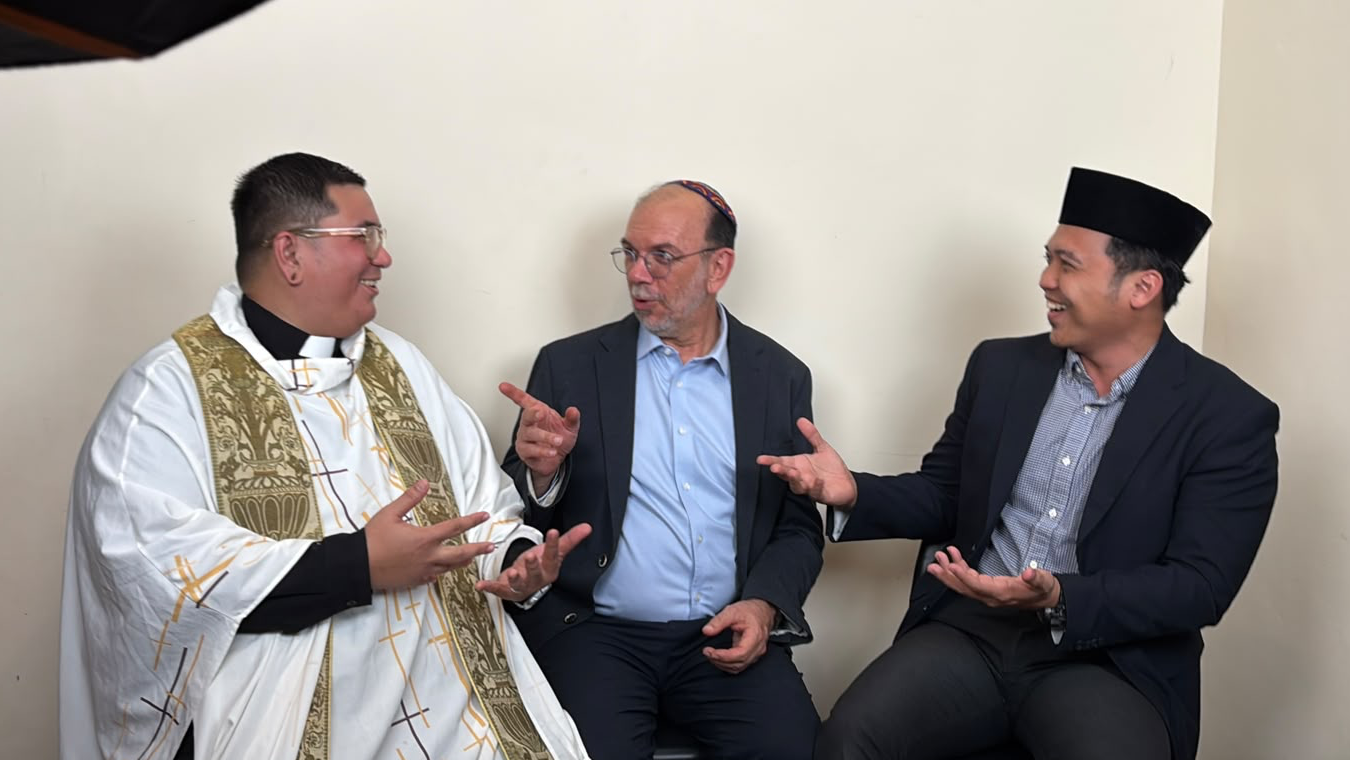
Each circle brings together an imam, a rabbi, and a pastor for a transformative three-week journey in which they live in one another’s homes, share meals (prepared appropriately), and connect with local communities. Imam Niki Fauzi from Yogyakarta, Indonesia, Rev Father Adrian Villaester from Iligan City in MIndanoia province in The Philippines, and myself embarked on our journey with a week in Iligan, a second in Yogyakarta, and the final week in my home in Melbourne.
I have worked in interfaith dialogue for more than 30 years, but this experience was unusually bold, intense and intimate – far removed from one-off events or short conferences. Living in close quarters left little room for pretence and revealed our quirks and customs, from Niki sharing meals with his wife and children on the floor to unfamiliar ablutions. Our group was equally diverse: a young Qur’anic theologian; a 40-year-old outreach priest with a passion for music who directs large Passion plays about the death of Jesus; and me, an experienced, Modern Orthodox rabbi. Despite our age differences, our shared ideas, humanity, humour and playfulness united us. Like Benjamin Button, I sometimes felt exuberantly 30 again – growing younger by the week!
The strength of this model lies as much in the relationships it builds as in the deeper understanding it fosters from another faith’s heartbeat. The informal moments between official engagements – meeting diplomats in Jakarta, Muslim university students in Yogyakarta, and interfaith groups in Iligan – are often the most powerful: quiet conversations over breakfast, on a walk through a busy street market, or along a river promenade. We discuss everything from Hadith and Halacha to attitudes towards transgender people and experiences of transcendence. We also share a love of the sacred and the powerful connection of prayer. Watching Nikki rise with ease at around 4.30 am-5.30 am in Melbourne – for Fajr prayers and attending Friday Jummah prayers at the Albanian Mosque in Carlton, gave me a fresh appreciation of the depth of Islamic prayer.
I also gained new respect for Christian devotion to compassion and for the strength of Filipino family and community bonds despite widespread, crushing poverty. There, religion is woven into daily life as deeply as it is in Ripponlea in Melbourne or Jerusalem’s religious neighbourhoods.
On Friday, as I prepared for Kabbalat Shabbat prayers in Yogyakarta, the muezzin’s call echoed through the air – a wondrous, winding and timeless evocation of prayer across our planet.
In Iligan, I saw Christian and Muslim leaders working together to rebuild trust after the devastating 2017 conflict in Marawi, when Islamic State forces caused widespread destruction. Mindanao’s local government actively supports this renewal and recovery, led by local bishop Stephen, Adrian’s father. One of my most moving experiences was visiting a hospital with imams and Christian clergy who comforted and prayed with patients and their families. I was invited to offer a Hebrew tefillah, which I hope contributed to the healing of this fractured community – the faces of those around us seemed to reflect this.
The example of these two faith communities reminds us what is possible in Australia and how interfaith action can help repair our damaged social cohesion.
Another important lesson came from Indonesia’s Islamic landscape. Its two largest Muslim organisations are Nahdlatul Ulama (NU), with more than 100 million adherents, and Muhammadiyah, with about 80 million followers. Nikki is a leader and Qur’an lecturer and serves on a Halachah – like legal body that issues rulings on contemporary questions. These organisations demonstrate a flexible, open outlook, particularly towards women and other faiths. A timely reminder that Islam is a vast religion with so many different strands… Aisyiyah, Muhammadiyah’s women-led organisation, is a formidable advocate for equal rights and a determined opponent of domestic abuse.
In our meetings with these Muslim leaders, I was able to challenge their views on Israel, including the binary thinking that treats Zionism as an evil separate from Judaism. I was also better able to appreciate how widespread the power of the media is in shaping Muslim attitudes to the State of Israel.
On one occasion, I was shocked by the defence of Hamas and argued that it seemed to me that it contradicted Islamic teachings. What struck me most, however, was our ability to discuss such issues calmly and respectfully – something that is currently almost impossible with much of Australia’s Muslim leadership.
Nikki and his wife later confided that our time together had prompted them to reconsider their views on Israel and recognise how social media silos poison dialogue and respectful disagreement. We agreed that the suffering of all people – especially children – whether in Israel, the West Bank, or Gaza, cuts deeply. Yet I believe none of us fully understands the trauma of the other.
I gained much from this extraordinary journey along the road less travelled. I returned with renewed hope that faith can help heal Australia, confidence in the friendship of many Christians, and a conviction that Jews and Muslims here and in the Middle East need not remain locked in perpetual conflict.
On this trip we focused on, and issued a statement on, climate change. In part it reads: We come from different Abrahamic faith traditions. We worship and pray in different ways and we have different histories, languages and theological traditions. Yet we share one Earth and one common responsibility… We do not inherit the earth merely for ourselves. We hold it in trust for those who come after us…

Creation in the Book of Psalms – a Jewish Perspective